
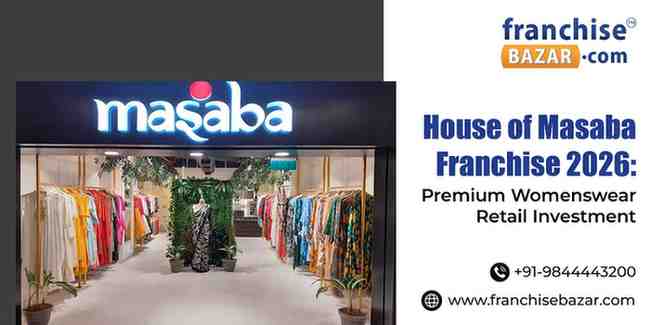
House of Masaba Franchise 2026: Premium Womenswear Retail Investment
Written By: Khushboo Verma
India's premium womenswear market has evolved into a structured, brand-driven retail segment where design credibility, celebrity association, and omnichannel reach matter significantly. The House of Masaba franchise stands out as a fashion brand that blends contemporary Indian aesthetics with strong commercial appeal.
For investors evaluating high-end fashion retail in 2026, this franchise presents an interesting opportunity. It positions itself between mass ethnic chains and ultra-luxury designers, targeting urban women who value design, brand identity, and versatility.
The Brand Story and Market Positioning
House of Masaba was founded by Masaba Gupta in 2009, gaining early traction for its bold prints, modern silhouettes, and strong celebrity endorsement.
Over time, it expanded from couture and festive wear into ready-to-wear ethnic, fusion apparel, and lifestyle extensions.
Key Milestones:
- Founded in 2009 by designer Masaba Gupta
- Acquired by Aditya Birla Fashion and Retail (ABFRL) in January 2022 for Rs 90 crore (51% stake)
- Annual revenue of Rs 70.3 crore as of March 2024
- Currently operates 17 flagship stores across India (as of December 2024)
- Targeting Rs 150 crore annual recurring revenue in 2024-25
- Five-year revenue target of Rs 500 crore set by ABFRL
What differentiates the house of masaba franchise from traditional ethnic brands is its ability to remain trend-forward while retaining Indian design roots.
The brand appeals strongly to urban women aged 25-45 who shop for weddings, festivals, workwear, and social occasions from the same label.
The backing from ABFRL provides operational infrastructure, strategic guidance, and access to an extensive retail network. This makes it a more stable franchise proposition compared to independent designer labels.
Why Premium Womenswear Is Attracting Investors
The Indian womenswear market reached USD 93.20 billion in 2024 and is projected to grow to USD 121.60 billion by 2033, exhibiting a growth rate of 2.70% during 2025-2033.
This growth is driven by rising disposable incomes, higher workforce participation among women, and growing demand for branded ethnic wear.
Market Growth Drivers:
- Increasing disposable income among urban women
- Rising preference for branded ethnic wear over unbranded boutiques
- Growing e-commerce penetration in fashion retail
- Expanding middle class and rapid urbanization
- Social media influence and celebrity endorsements
- Strong wedding and festive market in India
From an investment standpoint, premium womenswear offers three structural advantages.
- First, average ticket sizes are higher, supporting revenue density even in moderate-sized stores.
- Second, inventory cycles are predictable around festive and wedding seasons.
- Third, strong brands enjoy higher customer loyalty compared to unbranded boutiques.
This is where the house of masaba franchise fits well. It operates in a segment where brand equity directly translates into footfall, pricing power, and repeat customers.
The brand's Netflix series "Masaba Masaba" further enhances its visibility and recall among target consumers.
House of Masaba Franchise Business Model
House of Masaba typically follows a Franchise Owned Franchise Operated (FOFO) model.
Under this structure, the franchise partner invests in store setup, interiors, staffing, and working capital, while the brand provides design collections, visual merchandising guidelines, marketing support, and operational systems.
The brand maintains tight control over store aesthetics, product mix, and customer experience. This ensures consistency across locations, which is critical for a design-led fashion label.
Franchise partners benefit from centralized design and inventory planning, reducing the risk of unsold or outdated stock.
Additionally, seasonal collections are curated at the brand level, while stores focus on execution and local customer engagement.
The brand also offers its beauty line, LoveChild by Masaba, which can be retailed alongside apparel to increase average transaction values.
Investment Overview for 2026
The house of masaba franchise requires a premium-level investment, aligned with its brand positioning.
|
Investment Component |
Details |
|
Total Investment Range |
`Rs 80 lakh to Rs 1.2 crore |
|
Store Size Requirement |
800 to 1,200 sq ft |
|
Franchise Fee |
Included within total investment |
|
Interior and Fit-out |
High, due to premium design standards |
|
Initial Inventory |
Designer-led collections supplied by brand |
|
Working Capital |
Recommended for 6 months of operations |
|
Location Preference |
Luxury malls, high-street zones in metro/Tier I cities |
The exact investment depends on city tier, location type, and store format.
High-street locations and luxury malls generally require higher capital due to rentals and fit-out standards.
However, the brand's strong positioning justifies the premium investment.
Revenue Potential and Profitability
Premium fashion retail relies on average order value, brand loyalty, and seasonal spikes rather than volume.
A well-located House of Masaba store can generate strong monthly revenues during festive and wedding periods, with relatively stable sales in other months.
Typical Performance Indicators:
|
Performance Metric |
Range |
|
Average Monthly Revenue |
Rs 18-30 lakh |
|
Gross Margins |
45-55% |
|
Net Profit Margins |
12-18% (after all expenses) |
|
Break-even Period |
30-36 months |
|
Seasonal Revenue Spike |
30-40% during festive/wedding seasons |
Based on industry benchmarks for similar premium womenswear franchises in India.
Profitability depends heavily on rental efficiency, staff productivity, and inventory rotation.
Franchisees who actively manage visual merchandising and customer relationships tend to outperform passive operators.
The brand's centralized marketing campaigns and social media presence reduce local advertising costs.
Location Strategy and Store Performance
Location plays a decisive role in the success of a house of masaba franchise.
The brand performs best in areas with high concentration of premium shoppers, wedding-related spending, and lifestyle consumption.
Preferred Locations:
- Luxury malls in metro cities (Mumbai, Delhi, Bengaluru, Hyderabad, Chennai)
- High-street retail zones in affluent neighborhoods
- Premium mixed-use developments with lifestyle footfall
- Destination shopping districts with fashion-focused consumers
Moreover, Tier II cities with strong wedding markets and rising premium consumption are emerging as viable options.
The brand recently opened stores in Chandigarh and Ludhiana, indicating expansion beyond metro markets.
Cities with high disposable incomes and fashion-conscious populations are ideal.
The average store size of 1,000-1,200 sq ft allows for adequate display of collections without excessive rental costs.
Strategic placement near other premium fashion brands enhances customer traffic and brand positioning.
Brand Support and Operational Assistance
House of Masaba provides structured support to franchise partners, especially during the launch phase.
This includes assistance with store design, layout planning, visual merchandising, and staff training.
Ongoing Support Includes:
- Seasonal collection planning and inventory management
- Centralized marketing campaigns (digital and traditional)
- Strong social media visibility and influencer collaborations
- In-store branding and promotional materials
- Operational audits to maintain brand standards
- Training programs for sales staff on product knowledge and customer service
- Access to ABFRL's retail expertise and backend systems
The brand's strong presence on social media and celebrity endorsement (including its Netflix series) helps drive organic interest.
This supports franchise store footfall without excessive local advertising spends.
The Netflix show "Masaba Masaba" has significantly boosted brand recognition among younger consumers.
Risks and Considerations for Investors
While the house of masaba franchise offers strong brand value, it is not a low-risk or entry-level investment.
Fashion retail carries inherent risks related to inventory management, changing consumer preferences, and seasonality.
Key Risks Include:
- High initial capital commitment (Rs 80 lakh to Rs 1.2 crore)
- Dependence on festive and wedding seasons for revenue spikes
- Premium rentals in luxury locations impacting fixed costs
- Need for active operational involvement and retail expertise
- Fashion trend sensitivity and rapidly changing consumer preferences
- Longer break-even period (30-36 months) compared to lower-investment franchises
- Competition from established ethnic wear brands and luxury designers
Therefore, this franchise is better suited for investors with prior retail experience or those willing to be closely involved in daily operations rather than passive ownership.
Understanding the premium fashion segment and its customer expectations is essential.
Who Should Consider This Franchise Opportunity
The house of masaba franchise is ideal for:
Best Suited For:
- Investors with Rs 1 crore+ investment capacity
- Retail entrepreneurs with fashion or lifestyle experience
- Business owners looking to enter premium womenswear
- Partners seeking a design-led, brand-driven business
- Investors focused on long-term brand equity rather than quick returns
- Entrepreneurs with understanding of premium customer service expectations
Not Suitable For:
- First-time entrepreneurs seeking low-risk opportunities
- Low-capital investors
- Passive ownership models
- Quick-return seekers
The premium positioning requires sophisticated retail management skills and the ability to navigate seasonal fluctuations effectively.
Industry Outlook for 2026
The Indian ethnic wear segment is projected to grow at approximately 12% annually, reflecting ongoing appreciation for cultural heritage in fashion.
The overall Indian apparel market reached USD 115.70 billion in 2024 and is projected to grow to USD 178.5 billion by 2035, exhibiting a CAGR of 4.02% during the forecast period.
Additionally, around 60% of Indian consumers actively seek sustainable clothing options as of 2024.
House of Masaba is positioned to capitalize on this trend through its craft-focused approach.
The brand has initiated sustainability projects, including convertible clothing bags to reduce plastic waste.
The premium womenswear segment benefits particularly from India's robust wedding market and increasing consumer willingness to pay for branded, designer-led products.
With over 10 million weddings annually in India, the occasion-wear market remains a significant growth driver.
Final Assessment
In 2026, premium fashion retail continues to attract investors who understand the value of strong branding and customer loyalty.
The house of masaba franchise represents a well-positioned opportunity in India's evolving womenswear market.
It combines celebrity-led design credibility with structured retail systems and growing consumer demand for branded ethnic wear.
For the right investor profile, this franchise can deliver sustainable returns, strong brand association, and long-term growth.
Success, however, depends on location choice, operational discipline, and an active approach to retail management.
As with any premium franchise investment, thorough due diligence, realistic financial planning, and alignment with the brand's vision are essential before committing capital.
Prospective franchisees should conduct detailed market research in their target location, evaluate competition, and ensure they have sufficient working capital to sustain operations through the initial 30-36 month break-even period.
Key Takeaway:
The house of masaba franchise offers a compelling opportunity for experienced retail investors with adequate capital and a long-term perspective on premium fashion retail in India.
The brand's association with ABFRL, strong design identity, and celebrity appeal create a solid foundation for franchise success.
Disclaimer: The brands mentioned in this blog are the recommendations provided by the author. FranchiseBAZAR does not claim to work with these brands / represent them / or are associated with them in any manner. Investors and prospective franchisees are to do their own due diligence before investing in any franchise business at their own risk and discretion. FranchiseBAZAR or its Directors disclaim any liability or risks arising out of any transactions that may take place due to the information provided in this blog.
Recent Blogs

So, you’re thinking about joining India’s quick-service...
Thinking about opening a convenience store in India in 2027? You may...

If you are researching a Tumbledry franchise in India...

Biggies Burger is making waves in India’s burger scene,...

Why Should I Register?
You are seeking to access information which is provided only to registered members. It takes less than a minute to register and access information on FRANCHISEBAZAR.