
Cost to Start a Chai Sutta Bar Franchise in India 2027
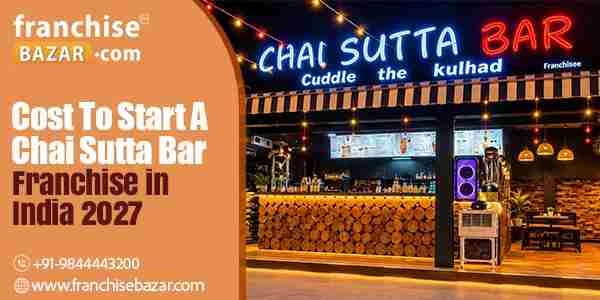
In India one can open a Chai Sutta Bar which will require an investment of between Rs. 22- 30 lakhs. As per the franchising section of their official website, the brand mentions that, “the total investment required for a Chai Sutta Bar ranges from Rs 22-30 lakhs.” Its FAQ lists two further charges:
- A token of about ₹2 lakh, which it calls non-refundable
- Sales royalties of 4%, charged monthly
The brand has not published the franchise fee or an itemised budget, and the range does not say whether rent deposit, licences, GST or working capital are included. This guide follows the money in the order it is spent, marks where the brand's pages are vague or contradict each other, and ends with what to settle before any money changes hands.
Chai Sutta Bar hasn't published separate 2027 pricing, so the figures below are the ones on its site as reviewed on 24 November 2026. Page dates are listed at the end.
Cost to start a Chai Sutta Bar franchise: the range, and what it leaves out
Minimum investment- INR 22 lakhs.
Applicants choose between two budget bands:
- ₹22–25 lakh
- ₹25–30 lakh
Whilst there is no information provided about what makes this brand stand out, it does state that the price will vary according to where and what atmosphere is required.
There is no itemised budget behind the number. Three things stay unclear:
- Franchise fee: the current page calls it non-refundable and gives no amount. Older articles on the brand's own website put it at ₹6 lakh in one place (QSR article, updated March 2024) and ₹6 to ₹12 lakh in another (franchise cost blog, updated June 2026), without saying whether it sits inside the ₹22–30 lakh.
- Rent deposit, licences, GST and working capital: none is mentioned.
- Interiors and machinery: the pages describe them but never price them.
That makes the range a planning guide rather than a quote.
Anyone with exactly ₹30 lakh has no room for a slow first few months. The sum committed should sit comfortably below the sum that can really be spared.
How the money moves
- Booking: the token of about ₹2 lakh, non-refundable, is paid first. The R&D team assesses the site afterwards.
- Approval: signed at the Indore head office. No figures are given.
- Build: interiors are built to company standards. The amount is not published.
- Training and supply: staff are trained for 15-20 days. Raw material and equipment are provided. No figures are given for this.
- Trading: the 4% monthly royalty begins.
- Ramp-up: rent, salaries and utilities come from reserves until the outlet earns. Working capital is not stated.
The order of the first stage carries a risk. A payment that can't be recovered may be made before anyone has judged whether the location works. Put in writing what happens to the token if the site is rejected before paying.
The royalty is a percentage of sales, not profit, so even in a slow month the full royalty is due. On monthly sales of ₹5 lakh, that comes to ₹20,000.
Chai Sutta Bar franchise in India: formats and cities
Three formats are described:
- Kiosk: small size offering 300-400 sq. feet of space and a limited menu range.
- Medium and mega: size and cost not published
The brand sets no mandatory outlet size. Since rent usually makes up the largest running cost of a cafe, the format should follow the site, and the investment for each format is worth requesting in writing.
On location:
- The enquiry page lists 101 cities as available for franchise.
- The homepage names recent openings in Gomti Nagar (Lucknow), Neeladri Nagar and Koramangala (Bengaluru) and Kukatpally (Hyderabad).
The brand gives no site criteria and no costs by city tier, so the assessment falls to the applicant:
- Count foot traffic at different hours
- Note every rival tea stall within walking distance
- Check for colleges, offices or busy market lanes
- Read the lease for rent rises after year one
The return claims
Large return numbers circulate around this brand, and its own pages don't agree with each other.
- Franchise cost blog (updated June 2026): average profit returns of 108%. (no source).
- QSR article (updated March 2024): 30–40% is seen as reasonable (no source)
- Homepage (November 2026): "massive margins" and a "high-ROI-driven" model, with no figures
None of them shows how the figure was reached or which outlets it covers, so each is best treated as an unverified claim.
The same caution applies to scale:
- The enquiry page reports 20 crore+ kulhads served. That speaks to network volume, not what one outlet sells.
- According to the QSR (March 2024), there are over 400 stores. However, the company’s homepage (November 2026) claims to have 650+ locations. Although the latter is more up-to-date, visiting a local branch is a more conclusive way of confirming the correct number.
Better evidence comes from the brand directly:
- Average monthly sales for the chosen format and city tier
- How many outlets opened in the last two years are still trading
- Contact details for existing franchisees
A percentage also means little without the investment base it was measured against, and none of the page’s states one. Until those figures are available, a percentage return deserves little weight.
Who it suits
The brand says no degree is required. Its stated requirements are:
- Basic tea-making and business knowledge
- Decent customer handling and a willingness to follow brand rules
- Passion for the brand
- A suitable location and a desire to succeed
The harder part is the model. This is franchise-owned and franchise-operated, with two to four staff per outlet, so supervision tends to fall to the owner.
It fits someone who can:
- Fund ₹22–30 lakh with a cash reserve on top
- Secure a retail spot with steady footfall
- Be present at the counter
The training described is for staff. An owner without cafe experience should plan to learn the operation at a working outlet.
The franchise fits poorly for:
- Anyone wanting a passive investment
- Anyone unable to absorb a few slow months at the start
How to open a Chai Sutta Bar franchise: enquiry to opening
- The enquiry form goes in, and the franchise team contacts shortlisted applicants.
- Photographs and details of the proposed site are shared.
- The token is paid.
- The R&D team assesses the site, then an area manager meets the applicant.
- The agreement is signed at the Indore head office.
- Interiors are built, staff train, and materials and machinery arrive.
Opening takes about 45–60 days on average, according to the brand. A delay in site approval pushes back every later stage.
Before signing
The FAQ lists "agreements and license" as a step but gives no term, no renewal terms and no outlet size, so the draft agreement is worth requesting early. The points to settle:
- Length of and re-licensing cost?
- Can another outlet open nearby?
- Are the machines and ingredients required to be sourced from the brand and at what cost?
- Which payments are refundable, and when?
- How are stores audited and what happens if an audit is not passed?
- Can the franchise be transferred or sold?
- What marketing support is included? The enquiry page mentions none.
- What support follows opening? The pages give no detail.
- What is the present franchise charge and does this encompass all associated costs (between rupees 22-30 lakhs)?
Reasons to proceed, reasons to stop
The case for going ahead rests on four things being true at once:
- The fee and inclusions are in writing
- The brand shares sales data for like-for-like outlets in a comparable city
- At least two existing franchisees talk openly about their first year
- The applicant's own cautious figures still hold up
The case for stopping is easier to spot. No outlet's results can be guaranteed, so any promise of guaranteed returns is a warning in itself. The same goes for:
- A cost breakup that exists only in conversation
- Pressure to pay the token before the site is assessed
- Reluctance to put applicants in touch with franchisees
- Sales figures that arrive as a single glowing example, not a range from several outlets
One of these justifies a pause. Two justify walking away.
An assessment of the brand
Chai Sutta Bar began in 2016 with three outlets in Indore, started by Anubhav Dubey and Anand Nayak. Rahul Patidar joined them later. Bhopal and Ujjain followed in 2017, and the brand's about page lists 85+ outlets by 2020, a move into Dubai, Nepal and Abu Dhabi in 2023, and 650+ outlets with a Canada launch in 2025.
What a customer sees is simple: chai in kulhads, which the brand presents as kinder to the environment than plastic, in a bar-style setting with no smoking, at pocket-friendly prices. That is the product an investor is buying into, so it helps to stand in a busy outlet and watch who orders what.
The brand's own numbers need care. The about page gives 320+ cities in one place and 370+ in another, while the homepage says 390+. Ask which count is current before relying on any of them.
The about page lists media mentions, including Aaj Tak, India Today and The Times of India, but no awards, so it is visible, though not recognised.
In its favour:
- The royalty and token are published
- The process is clearly explained
- The brand describes a supply chain management and audit system meant to keep outlets consistent
- A reported 650+ outlets across 390+ cities, a count that is the brand's own
Against that, the current pages give:
- No franchise fee
- No investment breakup
- No verified profit data
- No marketing support, and no detail on help after opening
None of these rules the franchise out. It is a list of items to settle in writing first. A brand that answers each of them in writing has earned a closer look.
Frequently asked questions
How much does it cost to start a Chai Sutta Bar franchise in India in 2027? The total investment is ₹22–30 lakh, starting from ₹22 lakh, according to the brand's enquiry page.
What is the royalty fee? 4% of sales per month, according to the FAQ.
How much is the token money? About ₹2 lakh, which the FAQ says is non-refundable.
What are the franchise requirements? No degree is needed. The brand lists a suitable location, passion for the brand and a desire to succeed.
How large is an outlet? The kiosk format is about 300–400 sq ft of seating space.
What does FOFO mean? Franchise Owned, Franchise Operated. The franchisee owns and runs the outlet and pays for the right to use the brand name for an agreed period.
Is a Chai Sutta Bar franchise profitable? The brand publishes no verified profit figure. Profit depends on sales, rent and costs at each site, so outlet-level numbers should be requested.
Can an outlet be opened in a smaller city? The enquiry page lists 101 cities as available. A particular town should be confirmed with the franchise team.
Written By Resham Daswani, FranchiseBazar Editorial Team Updated November 2026 ·
Disclaimer: The brands mentioned in this blog are the recommendations provided by the author. FranchiseBAZAR does not claim to work with these brands / represent them / or are associated with them in any manner. Investors and prospective franchisees are to do their own due diligence before investing in any franchise business at their own risk and discretion. FranchiseBAZAR or its Directors disclaim any liability or risks arising out of any transactions that may take place due to the information provided in this blog.
Recent Blogs

Yes. Entrepreneurs can send a Dominos...
In India one can open a Chai Sutta Bar which will require an investment...

Bikanervala franchise cost in India is...

Why Should I Register?
You are seeking to access information which is provided only to registered members. It takes less than a minute to register and access information on FRANCHISEBAZAR.