
Is Subway Franchise Worth It in India? 2027 Cost, Fee, ROI & Payback
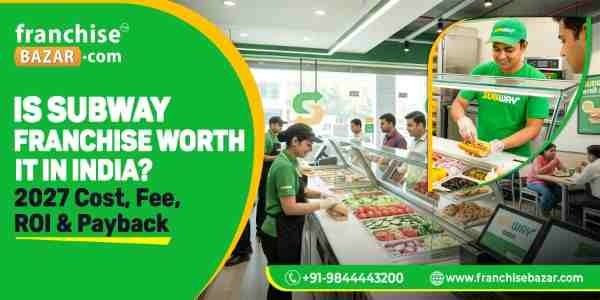
Should I Invest In A Subway Franchise In India In 2027?
Although a Subway franchise could be an appealing food business opportunity in India due to it being well known internationally, having an existing network throughout India and offering a customisable menu, how much profit you make will depend on your location, investment, running costs, sales and franchise agreement.
One thing to note is that Subway operates in India through EverBrands and affiliated companies. Whilst they have been increasing their network, they have recently been focusing more on company owned and operated restaurants. This may impact how many individual franchise opportunities are available.
Before you decide to invest, only consider Subway once you have confirmation in writing of how many franchises are available, your total investment, any ongoing fees, territory rights and what the expected running costs will be.
This guide will explain how much a Subway franchise is likely to cost in India in 2027, including potential fees, how to apply, whether it can be profitable, ROI, payback period and main risks. We will also show you what you should confirm directly.
How Much Does Subway Cost 2027
The exact price ranges can't be determined but most guides will say that an investment of between ₹60 lakh to ₹1.1 crore is needed to buy a Subway franchise in India. It depends on the city you want to establish your brand in, the property you own, size of the outlet, building requirements, equipment and contracts. https://nextwhatbusiness.com/subway-franchise-cost-in-india/ The majority of the third-party franchise guides will quote anywhere between ₹60 lakh and ₹1.1 crores as an average. This can also be higher if you plan to get a coveted location in your city. According to Next What Business' Subway Franchise Guide 2026, sometimes it costs around ₹1.5 crores for prime locations in the metro cities. While this can be helpful to give you an estimate of what you are likely to pay, it is not a replacement for having an official written quotation from the approved operator in India.
Your investment may include:
Inv
|
Investment component |
What it covers |
|
Franchise or licence fee |
Brand and operating rights, if offered |
|
Property deposit |
Security deposit and advance rent |
|
Interiors |
Counters, flooring, seating and signage |
|
Kitchen equipment |
Refrigeration, ovens and preparation units |
|
Technology |
Billing, POS and related systems |
|
Licences |
Food, trade and local permissions |
|
Opening inventory |
Ingredients, packaging and supplies |
|
Recruitment |
Hiring and initial training |
|
Working capital |
Cash for early operating expenses |
Don't focus solely on the franchise fee for the investment. Be sure there is sufficient cash flow to support wages, rent, stock, the utilities and miscellaneous expenses until sales are up and running. Request a line item how the costs would breakdown. • Refundable deposits. • Non-refundable cost. • Equipment. • Building. • Tax and cash flow. • Is GST included? • Is the rent of the property included?
How much is the Subway franchise fee?
Initial franchise/licence fee is only part of your investment. How much you need to pay as an Indian applicant is to be verified with official Subway India team. Your browsing can retrieve different pricing that on websites. However these may be stale, for a different country, or simply a copy of another franchise listing. While the Subway international FAQ page is a good place to find out how Subway work as a franchise, this is not always relevant to India. For example the US franchise info states a 8% royalty fee and 4.5% advertising fee. These will not necessarily be what you will need to pay on your new agreement in India. Source :https://www.subwayfranchise.com/en-us/faqs
Before you agree, get written responses to this:
- What is the franchise/licence initial fee?
- Do you charge any royalty fee? How much and on what?
- Are there any marketing costs?
- Are there any additional costs for the tech, software or supply chain?
- Are there any minimum sales or running requirements?
- Who will pay for any necessary refurbishments or new equipment?
- What if the contract is ended?
Always consult your model at current prices in India Your consultant should give you concrete documentation to support the fee they quoting.
Who operates Subway Franchisee
In November 2021, Subway announced it was entering into its master franchising agreement with Everstone Group. This covers India, Sri Lanka and Bangladesh. View the full news article here.
The Indian business is run under the brand EverBrands. They run Subway under their quick service restaurants business. Find out more about the company and brand by visiting the EverBrands website.
Recent reports have suggested that EverBrands has 1,008 Subway stores in India (March 2026). Source :https://www.moneycontrol.com/news/business/ipo/norwest-capital-backed-subway-restaurants-operator-everbrands-india-files-drhp-for-rs-600-crore-ipo-14041041.html
This includes:
678 franchisor owned stores
330 franchisee owned stores
As reported by Moneycontrol September 2026.
Also reported by Business Standard regarding the EverBrands IPO.
Just because there are a large amount of stores does not mean that there will be an opportunity for franchisees but it is possible that there are expansion plans in place and more franchisor owned stores will be opened.
Tip: Always contact the official franchisee for India before paying a fee to a broker/consultant/website.
How To Apply For A Subway Franchise In India
Complete the official enquiry form on the Subway India website. This will help you ascertain if they are looking for applicants in your desired city.
You may be asked:
1) Enquire: Complete the details accurately including contact details, business background and location.
2) Financial Readiness: Be able to demonstrate how much money you have to invest.
3) Preferred Area: Tell them which city/area and property you would like.
4) Business Assessment: The official team may want to assess your experience, Financial Readiness and suitability.
5) Business Terms: You will receive written terms of your investment, fees, agreement length, operating terms and renewal terms.
6) Site Approvals: Ensure you have the correct approvals in place before signing any leases or commencing any building work.
Just because you have made an enquiry doesn’t mean you will be approved. Don’t pay anyone who can guarantee you will be selected, guaranteed profits or a guaranteed territory without official documents.
Always use the contact information provided by Subway India or EverBrands. Always check who you are paying and the payment details.
Best Location
A good location is essential for a fast food restaurant. If the location is bad then having a well-known brand isn't going to help. You want a spot with good exposure, high demand and not too much overhead.
Consider high streets, office parks, shopping centres, college areas, hospitals, transportation centres and high density areas.
However, you don't just want to pick a place that just has lots of people walking past. You want a place with people who will buy at prices that will allow the operating costs to be covered.
Research the area. Look at how busy it is, competition in the area, how many deliveries are going out and what the locals like. Look at how busy it is during the week and at the weekends.
Compare the rent to the potential sales. A prime spot in a shopping centre may seem great, but can quickly become expensive if there is too much rent and maintenance.
Before entering into an agreement check with the brand if it's an acceptable location. Also check if there can be another Subway nearby. Get written confirmation about how protected your territory is. You may not get exclusive rights to an entire area.
Subway franchise profit
There isn't a real public number that you can rely on for how much profit you can expect to make on a new Subway franchise in India per month. This depends on many factors such as sales, food costs, staff wages, rent, delivery fees, utility costs, taxes and franchise fees.
This is just an example to use when planning.
Let's say your restaurant makes ₹12Lakh in sales per month. Your running costs could be:
|
Expense |
Illustrative monthly amount |
|
Food and packaging |
₹3,60,000 |
|
Salaries |
₹1,80,000 |
|
Rent and occupancy |
₹1,20,000 |
|
Utilities |
₹50,000 |
|
Illustrative brand-related charges |
₹1,50,000 |
|
Other operating expenses |
₹1,40,000 |
|
Total expenses |
₹10,00,000 |
|
Illustrative operating surplus |
₹2,00,000 |
The brand fee is just an example and does not reflect the actual royalty and advertising fees charged by Subway India.
This profit doesn't necessarily mean you will get this amount. There could be interest, depreciation, income tax, owner payments, loan repayments and large repair costs.
Create 3 scenarios:
Pessimistic – Lower than expected sales. Rent and wages will be mostly fixed.
Expected – Sales will be based on your research and realistic customer demand.
Optimistic – Higher sales with little increase in running costs.
If your business only makes sense in an optimistic scenario then consider if you want to invest. Ask for the assumptions made when forecasting sales. Are they using similar stores in similar locations across India?
ROI & Payback Period
ROI stands for Return On Investment. The payback period indicates how long it will take to make back your initial investment from the cash flow of the business.
Let's say:
Investment = ₹70Lakh
Annual Profit = ₹24Lakh
Basic ROI = ~34.3%
Basic Payback Period = ~35 Months
Calculation:
Annual Profit = (24 / 70) x 100 = 34.3%
Basic Payback = 70 / 24 = 2.92 Years
These are just examples and do not reflect what you could expect to make on a Subway franchise. These examples are basic and do not take taxes, finance costs, depreciation, extra investment or changes in sales into consideration.
You could have a much longer payback period or even none at all if the store is regularly losing money or closes early.
Ask the operator for financial information on similar stores in India if possible. Find out if these are company owned or franchisee owned as they could have different running costs.
Benefits of owning a Subway outlet
Well-known brand name – Subway is a well-known international brand in the food industry and has an existing presence in India.
Flexible – You have a variety of options for your customers to choose their ingredients and combinations.
Variety of products – Subways have a variety of products such as sandwiches, salads etc. that can attract customers looking for food/snacks.
Franchise – If you are using a franchise you may get extra help with training, brand guidelines, approved products and guidance. (Depending on the agreement in India.)
Existing brand – You will have an existing brand in India which helps attract customers.
Whilst these benefits can attract customers, they do not guarantee sales and profits. You will still have to manage the quality of your
service, stock, staff and overall customer experience.
Risks to consider
Upfront costs – There could be high costs of setting up the outlet, deposits and working capital.
Monthly fixed costs – Monthly costs such as rent, salary and utilities.
Competition – You may face competition from other sandwich shops, cafes, bakeries, local restaurants and other fast food brands.
Branding – If you are using a franchise you usually have to follow brand guidelines. This includes menu, supplies, service and design.
Area – Don’t assume you will have exclusive rights to an area. Be sure to check the agreement.
Ownership changes – As reported by Financial Express recently, EverBrands have been increasing their owned stores. It’s important to ensure there are new franchising opportunities available. Source :https://www.financialexpress.com/market/ipo-news-ipo-bound-subway-india-makes-a-big-ownership-shift-4351033/
Low margins – Commissions from aggregators, discounts and packaging can mean the margin on online sales are low.
This is not a set-and-forget investment. You will need skilled management, consistent service, stock control and monitoring the performance.
Things to check in your agreement
Ensure you ask for the full agreement and have a professional franchise solicitor and accountants look over your agreement.
Make sure to check:
- Length of agreement and renewal terms.
- Set-up costs and ongoing costs.
- Approved suppliers and what you can purchase from them.
- Site approval and moving site.
- Area protection and nearby outlets.
- Sales reports and auditing rights.
- Training and support.
- Refurbishment requirements.
- Termination rights and penalties.
- Limitations after agreement.
Ensure you have checked any food safety regulations, local trading regulations, fire safety regulations, employment regulations and tax regulations. Food businesses need to be registered/licensed in India. Find out more about registering with FSSAI and check the FoSCoS portal. Make sure your premises are in the right category and have the correct requirements.
Don’t take any verbal promises of income, guaranteed returns or exclusivity. Ensure any important commitments are in your signed document.
Subway or own Sandwich Shop?
A franchise will give you a brand to work with and a whole system. Whereas if you own your own sandwich shop, you will have more control over how much you charge, what you sell on your menu, your suppliers and your brand.
However, you will need to put a lot of work into developing your brand and building up your customer base. Franchise systems can be expensive and restrictive.
Using these factors (Property costs, Start-up costs, Monthly Turnover, Food Costs, Labour Costs, Marketing, Delivery Charges & Working capital) you will be able to see which option is best for you.
Ultimately your decision will be based on how experienced you are within the industry, how much money you have to invest, how risky you are willing to be and what terms you are given. Don’t get tempted by the brand name.
Conclusion: Is Subway Franchise a good Investment
Although Subway is potentially an interesting opportunity, only invest if the Indian operator assures you they will accept your application and give you a written business proposal.
Whilst the brand is well known and has an established platform in India, costs quoted online will not give you a definitive answer. International royalty rates do not equal Indian royalty rates.
You need to consider:
Are there any franchises available? How much is the total investment? Are there realistic numbers at outlet level? What are the terms of the agreement?
If there are realistic numbers with conservative sales assumptions, it is a good location with a contract that protects you. However if the business relies on optimistic revenue and unclear fees, then turn it down.
The best investment is not necessarily the most well-known franchise. It is the one that has realistic figures.
FAQs
What is the cost of a Subway Franchise in India in 2027?
The cost of a standard Subway franchise is estimated by third parties to be between 60 lakhs and 1.1 crores. This is just a general figure, please see what the cost was in 2026 and contact us directly for the actual cost.
What is the fee charged for a Subway franchise in India?
To find out what the fee is for a new franchisee in India please contact the official operator directly.
Are franchises available at the moment?
Please use the official enquiry option. It cannot be guaranteed that you will be approved for a new franchise. Please check if they are available in your city.
How much profit can I earn per month?
There is no guaranteed profit. This depends on how much you sell, how much rent you pay, staff salary, food costs, fees and delivery costs. Please create a business plan for your location.
How long until I get my money back?
There is no verified time frame. Please calculate based on your actual investment.
Can I apply if I do not have property?
You can start by using the official enquiry option. Please contact the operator to confirm if you need property and if your site will be approved.
Research
The information used in this article has been sourced from publicly available brand sources, company statements, recent news articles, third party estimates of franchise costs and Indian regulatory sources. Third party cost estimates have been noted. Calculations have been used to give an indication of how financially viable the Subway franchise would be.
Sources
- Subway India — brand and Indian market information.
- Subway India franchise enquiry — official enquiry route.
- EverBrands — information about the Indian operating platform.
- Subway's 2021 Everstone master franchise announcement — original partnership announcement.
- Moneycontrol, September 2026 — reported store ownership split and company information.
- Business Standard, September 2026 — additional reporting on EverBrands' proposed IPO and store network.
- Financial Express — reporting on the shift towards company-operated stores.
- FranchiseBazar — third-party franchise cost guide.
- NextWhatBusiness — third-party 2026 cost and investment estimates.
Written By Gouri Ghosh, FranchiseBazar Editorial Team Updated November 2026 ·
Disclaimer: The brands mentioned in this blog are the recommendations provided by the author. FranchiseBAZAR does not claim to work with these brands / represent them / or are associated with them in any manner. Investors and prospective franchisees are to do their own due diligence before investing in any franchise business at their own risk and discretion. FranchiseBAZAR or its Directors disclaim any liability or risks arising out of any transactions that may take place due to the information provided in this blog.
Recent Blogs
Should I Invest In A Subway Franchise In India In 2027?
Although...

Metropolis doesn't publish a franchise fee or a total investment...

To start a YLG Salon franchise in India in 2027, fill in the Apply...

What Are the Best Retail Franchise Opportunities in India in 2027?
Some...

Why Should I Register?
You are seeking to access information which is provided only to registered members. It takes less than a minute to register and access information on FRANCHISEBAZAR.