
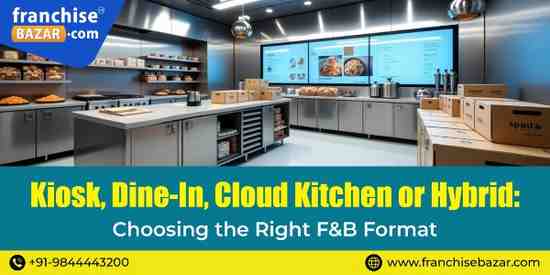
Kiosk, Dine-In, Cloud Kitchen or Hybrid: Choosing the Right F&B Format
Written By: Khushboo Verma
When investing in a food and beverage franchise, brand comparison and finding the right location often take center stage. Format rarely gets the same scrutiny. A wrong format call drains returns even when the brand and location are right.
India's food services industry was valued at approximately USD 85 billion in 2025 and is projected to reach USD 120 to 125 billion by 2030, per the Kearney-Swiggy "How India Eats 2025" report. The organised segment is clocking 12 to 14% CAGR. In this market, understanding food and beverage franchise formats is a financial decision that needs to come before anything else.
This guide is for anyone working through a food and beverage franchise investment India decision who wants to understand each format before committing.
Why Format Shapes Everything
Two investors with the same brand and similar capital can end up with completely different outcomes based on format alone. A kiosk and a dine-in outlet on the same brand will have entirely different cost structures and breakeven timelines.
Format sets your rent-to-revenue ratio, staff headcount, breakeven period, and daily operational load. Across all food and beverage franchise formats, the decision comes down to capital efficiency, risk exposure, and scalability.
1. Kiosk Format: Compact, Focused, High Velocity
Malls, metro stations, IT parks, and airports are where kiosks perform best, especially for brands with a tight menu. Brands like Chaayos, Keventers, and Roll Fresh have used this format to expand across locations without full-outlet overhead.
Typical Setup
|
Parameter |
Details |
|
Space |
100 to 300 sq ft |
|
Investment |
Rs 8 lakh to Rs 25 lakh |
|
Staff |
2 to 4 employees |
|
Revenue Model |
Takeaway and delivery |
|
Seating |
None or very limited |
Investment depends on the brand, mall tier, and fit-out requirements. Premium locations like airports or high-end malls are at the higher end of the investment scale.
Advantages
- Rental cost is considerably lower than any full-format outlet
- Faster launch timelines mean earlier revenue
- Straightforward operations, practical for first-time owners
- Low staffing keeps HR risk in check
Limitations
- Format limits how far the menu can grow
- No table service means no upselling opportunity
- No delivery buffer means a bad location is very hard to recover from
- Ticket size per order is smaller than dine-in
Breakeven: 12 to 18 months in high-footfall zones; up to 24 months in lower-traffic locations.
The Indian QSR segment was valued at USD 27.8 billion in 2025, growing at 9.26% CAGR through 2031. For first-time investors exploring food and beverage franchise formats, kiosks are a practical entry point, particularly in Tier-II cities where mall infrastructure is picking up.
2. Dine-In Format: Experience, Ticket Size, and Brand Recall
Dine-in is built around giving customers a reason to sit, stay, and spend more. Brands like Barbeque Nation, Burger King, and Wow Momo operate this way. It also carries the steepest setup costs and most demanding daily operations of any format.
Typical Setup
|
Parameter |
Details |
|
Space |
500 to 2,000+ sq ft |
|
Investment |
Rs 30 lakh to Rs 2 crore+ |
|
Staff |
8 to 20 employees |
|
Revenue Model |
Dine-in, takeaway, and delivery |
|
Seating |
Full structured layout |
Metro high-street locations push the investment higher. Civil work adds further to the initial outlay.
Advantages
- Higher order value per table visit
- Physical presence builds brand recall in ways delivery cannot
- Full menu creates natural upselling across courses
- Right infrastructure supports a wide range of menu categories
Limitations
- Rent is fixed whether the tables are full or empty
- Interior investment is largely unrecoverable if the outlet closes
- Working capital stays high throughout the year
- Front-of-house and kitchen both need experienced management
Breakeven: 18 to 36 months. The rent you lock in and how busy that location actually gets on a regular week will decide where in that range you land.
Full-service restaurants held 32% market share in India's foodservice sector in 2024 and are projected at 11.28% CAGR to USD 64.72 billion by 2030, per Mordor Intelligence. The segment has room to grow, but if your working capital runs thin in month eight, none of that matters.
3. Cloud Kitchen Format: Delivery-First Economics
A cloud kitchen is a cooking facility with no storefront, no seating, and no walk-in customers. Orders come through Swiggy, Zomato, or a brand app. Biryani By Kilo, Faasos, and Box8 built scale using this model.
Typical Setup
|
Parameter |
Details |
|
Space |
200 to 800 sq ft |
|
Investment |
Rs 5 lakh to Rs 30 lakh |
|
Staff |
4 to 8 employees |
|
Revenue Model |
Aggregator platforms and direct app orders |
|
Walk-in Customers |
Not applicable |
Shared kitchen facilities reduce entry costs further. Standalone units in secondary city zones fall mid-range on investment.
Advantages
- No premium location needed, which keeps real estate costs low
- One kitchen can run multiple brand identities
- Quickest format to replicate across new zones
- Front-end staffing is minimal
Limitations
- The entire revenue stream runs through third-party platforms, a dependency that carries real risk
- Aggregator commissions run between 20 and 30% of order value, per Mordor Intelligence
- Without digital marketing, the brand stays invisible
- Delivery customers are discount-driven and easy to lose
Breakeven: 12 to 18 months with consistent platform orders; beyond 24 months if discounting is heavy or volume stays low.
India's cloud kitchen market was valued at USD 1.13 billion in 2024 and is projected to reach USD 2.84 billion by 2030 at 16.7% CAGR, per Research and Markets (2025). Anyone evaluating a food and beverage franchise investment India in this format must map out commission costs before committing. Margins look better on paper than in practice.
4. Hybrid Format: The Balanced Approach
The hybrid model runs dine-in and delivery from the same space. Brands like Theobroma and The Belgian Waffle Co. work this way. In 2026, it suits investors who want multiple revenue streams without full dine-in costs.
Typical Setup
|
Parameter |
Details |
|
Space |
400 to 800 sq ft |
|
Investment |
Rs 20 lakh to Rs 50 lakh |
|
Staff |
6 to 12 employees |
|
Revenue Model |
Dine-in, takeaway, and aggregator delivery |
|
Seating |
Typically 20 to 35 covers |
Advantages
- Two revenue channels mean no single source can sink the unit
- Walk-in revenue holds when delivery margins compress
- Delivery picks up during off-peak dine-in hours
- Rental outgo is lower than a full dine-in setup
Limitations
- Two channels require tighter process management
- Kitchen and floor both need consistent oversight
- Entry cost is higher than a kiosk or basic cloud kitchen
Breakeven: 15 to 24 months when both channels are working. Delivery volume is the number to watch.
For mid-range investors evaluating food and beverage franchise formats, the hybrid setup gives the most workable risk-to-return balance in today's market.
Format Comparison
|
Format |
Investment |
Breakeven |
Risk Level |
Best For |
|
Kiosk |
Rs 8L to Rs 25L |
12 to 18 months |
Moderate |
First-time investors |
|
Dine-In |
Rs 30L to Rs 2Cr+ |
18 to 36 months |
Higher |
Experienced investors |
|
Cloud Kitchen |
Rs 5L to Rs 30L |
12 to 24 months |
Platform-dependent |
Digital-first operators |
|
Hybrid |
Rs 20L to Rs 50L |
15 to 24 months |
Balanced |
Growth-stage entrepreneurs |
These are realistic ranges, not guarantees. A bad location or weak operations in the first few months will stretch every one of these timelines.
How to Choose: 5 Questions to Answer First
1. What is your actual investment capacity? Count setup costs, working capital, and at least 6 months of operating expenses. Do not plan around best-case numbers.
2. What level of risk can you absorb? Dine-in locks you into fixed costs. Cloud kitchens put you at the mercy of platform policies. Kiosks live and die by footfall. Be clear on your threshold before you sign.
3. What does the local market look like? Is it delivery-heavy or mall-driven? Corporate zone or college belt? The format has to match how people in that area actually spend.
4. How involved can you be operationally? Dine-in needs daily floor presence. Cloud kitchens need someone watching platform performance. Kiosks need tight stock and location management.
5. What format does the brand actually support? Some brands are designed for kiosk rollout. Others depend on a sit-down experience.
Common Mistakes to Avoid
Here are the most common errors investors make when choosing between food and beverage franchise formats.
- Selecting a format because it is trending rather than because it fits the specific market
- Not accounting for 3 to 5 year rental lock-ins when evaluating dine-in
- Leaving delivery commissions out of cloud kitchen profit calculations
- Spending on interiors beyond what the location's revenue can realistically support
- Taking on more space than the business model can fill
Trends Driving Format Decisions in 2026
- Online food delivery in India is projected at USD 54.97 billion in 2025. Tier-II and Tier-III cities are emerging as the next demand belt, strengthening the case for cloud kitchen and hybrid formats outside metros.
- Rising metro rents are making large dine-in formats harder to justify without strong revenue projections.
- Multi-brand cloud kitchens are gaining ground, letting operators run different categories from one kitchen without proportionally higher fixed costs.
FAQ
Q1. Which format breaks even the fastest? Kiosks and cloud kitchens typically recover investment within 12 to 18 months in the right location. Dine-in takes 18 to 36 months.
Q2. Is cloud kitchen profitable in India in 2026? Yes, but margins are thin. Profitability depends on order volume and keeping commissions and discounts in check.
Q3. Which format suits a first-time investor best? Kiosks. Lower capital, simpler operations, and a shorter breakeven period make them the most manageable entry point.
Q4. Can one kitchen run multiple brands? Yes, running multiple brand identities from one kitchen is a core advantage of the cloud kitchen model.
Q5. Is dine-in still worth investing in during 2026? Yes, in the right conditions. Metro locations, proven brands, and sufficient capital reserves are what make it work.
Ready to Take the Next Step?
If you have a format in mind, the next step is finding a brand that fits it. Get clarity on the full investment figure including hidden costs, what support the franchisor provides post-launch, and whether the brand has traction in your target city. Talk to existing franchisees, not the sales team. The 2026 F&B market offers opportunities across all four formats, but success goes to those who do thorough research first.
Conclusion
No format works for every investor. The right one depends on your capital, city, brand, and operational capacity. Getting clear on food and beverage franchise formats before you commit keeps the decision financially sound. If you are working through a food and beverage franchise investment India decision, settle the format first. Everything else follows.
Disclaimer: The brands mentioned in this blog are the recommendations provided by the author. FranchiseBAZAR does not claim to work with these brands / represent them / or are associated with them in any manner. Investors and prospective franchisees are to do their own due diligence before investing in any franchise business at their own risk and discretion. FranchiseBAZAR or its Directors disclaim any liability or risks arising out of any transactions that may take place due to the information provided in this blog.
Recent Blogs

Looking to enter India's diagnostics sector without setting...
Introduction
The Indian salon and beauty industry...

Thinking about opening a diagnostic centre in India? It’s...
So, you’re thinking about joining India’s quick-service...

Why Should I Register?
You are seeking to access information which is provided only to registered members. It takes less than a minute to register and access information on FRANCHISEBAZAR.