
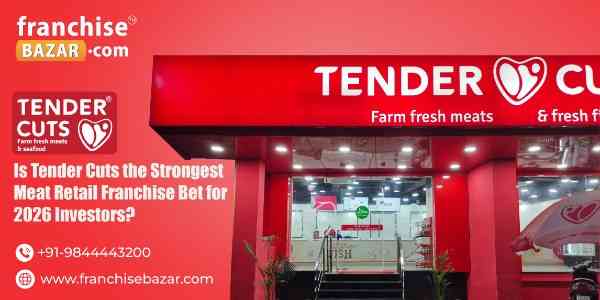
Tender Cuts Franchise-India's Strongest Meat Retail Franchise for 2026
Written By: Khushboo Verma
India's organized meat and seafood retail sector has entered a decisive growth phase. Rising consumer demand for hygienic, traceable, and packaged meat has pushed modern retail formats far ahead of their early adoption curve. Urban households, especially in metros, are buying fresh meat online and offline with higher frequency than ever before. With this shift, investors are asking one clear question in 2026: is the tender cuts franchise the strongest meat retail opportunity this year?
To answer this, we examine industry fundamentals, Tender Cuts' position in the market, unit economics, competitive comparisons, and the operational realities investors must consider before committing capital.
Why Meat Retail Has Emerged as a High-Growth Investment Category
Across major Indian cities, the organized meat market has grown rapidly due to lifestyle changes and a shift toward branded food products. A few key drivers stand out:
- Growing preference for clean, antibiotic-free poultry and seafood
- Busy urban lifestyles leading to higher adoption of ready-to-cook formats
- Increased confidence in cold-chain logistics
- Digital grocery platforms normalizing home delivery
- Urban families willing to pay premiums for hygiene and consistency
According to market research from IMARC Group, India's meat market reached USD 55.3 billion in 2024 and is projected to reach USD 114.4 billion by 2033, growing at a CAGR of 8.5%. This behaviour shift mirrors the trend seen in pharmacies, diagnostics, bakeries, and ice cream retailing, where organized formats took over fragmented traditional segments. The same playbook is now unfolding in meat retailing.
However, organized players currently account for only 20% of the total market, while unorganized players still hold 80%. This means massive room exists for expansion.
Tender Cuts in 2026: What Sets This Franchise Brand Apart
Tender Cuts entered the market in 2016 with a simple proposition: deliver farm-fresh, chemical-free meat through a controlled supply chain and modern stores. Over the years, the brand has built a strong presence in Chennai, Hyderabad, and Bengaluru through a mix of retail outlets and online delivery.
In September 2025, Tender Cuts became India's first omnichannel meat and seafood brand to achieve profitability. The company reported a store-level EBITDA of 10% and overall EBITDA of 1% on revenues of INR 5.6 crore in August 2025. Year-on-year revenue growth stood at 40%, marking a strong recovery.
By December 2025, Tender Cuts Franchise is positioned as:
- A premium fresh meat brand
- A hybrid online plus offline model
- A vertically integrated supply chain operator
- A brand with strong recall among metro households
Investors considering a tender cuts franchise in 2026 are looking at a category where brand trust and supply chain control matter more than aggressive marketing. This makes the segment structurally different from QSR businesses that rely on menu innovation and footfall cycles.
Evaluating the Franchise Model Of Tender Cuts: Four Critical Success Factors
To evaluate whether the tender cuts franchise stands out for 2026, we break down the four pillars that determine long-term success: supply chain, unit viability, brand differentiation, and market saturation levels.
1. Supply Chain Strength
Fresh meat retailing depends heavily on cold-chain efficiency, vendor management, and cutting operations that maintain uniform standards. Tender Cuts has invested in:
- Own processing centres
- Daily farm sourcing
- Skilled butchers trained in standard cuts
- Controlled logistics and packaging
- Temperature-regulated stores
This structure allows franchise owners to operate without building backend capabilities. As a result, franchisees benefit from a turnkey system where supply chain complexities are handled centrally.
2. Store-Level Economics
Fresh meat retail outlets follow a consistent revenue pattern:
- High daily repeat demand
- Weekend order spikes
- Steady online delivery contribution
- Low wastage if cold-chain is stable
A franchise outlet usually generates strong volume as long as the catchment has residential density. Moreover, Tender Cuts benefits from being in a necessity category rather than a discretionary one. Consumers return weekly, which stabilizes revenue and shortens the breakeven period.
Additionally, TenderCuts currently operates 18 outlets, each covering a 4 km radius, serving the Chennai market with fresh meat and seafood. By March 2027, the company aims to expand to 50 outlets.
3. Brand Recall and Consumer Trust
Consumers buying chicken, mutton, or seafood are highly sensitive about hygiene and freshness. Tender Cuts has positioned itself as a trustworthy premium brand through:
- Transparent sourcing
- Clean retail outlets
- Consistent portioning
- Value-added cuts and marinated items
- Made-to-order model (cleaning, cutting, and packing after order placement)
This reputation allows the brand to command premium pricing, directly improving margins for franchisees. Furthermore, customers can track their orders through the TenderCuts freshness tracker integrated into its online meat delivery app.
4. Market Opportunity and Competition Levels
India's organized meat market is far from saturated. Even in metros, traditional shops dominate more than 60% of sales. This means organized brands are still in the early stages, giving Tender Cuts room for expansion.
However, competition from Licious, FreshToHome, and local chains is strengthening. This can be both a driver (increasing category awareness) and a challenge (pressure on franchise profitability if differentiation slips).
Licious announced plans to go public in 2026 and has expanded 30-minute delivery to serve 60% of its 1.2 million customers. FreshToHome operates in 160 cities across India and has introduced 10-20 minute delivery in select locations. Meanwhile, Zappfresh became profitable in FY24 with INR 4.7 crore net profit.
Capital Requirements and Returns: A Realistic Franchise Breakdown
While Tender Cuts has not publicly published franchising terms as aggressively as other F&B brands, industry estimates and comparisons with similar formats provide a realistic framework.
Typical Investment Range
- Setup and interiors: Moderate, due to refrigeration, cutting area, and branded store design
- Equipment: Deep freezers, chillers, workstations, POS systems
- Franchise fee: Depends on city tier and store size
- Working capital: Essential for daily procurement
Unlike QSR categories, a tender cuts franchise requires higher backend coordination but lower labour dependency since kitchen operations are absent.
Revenue and Profit Potential
Fresh meat outlets usually benefit from:
- High basket value
- Weekly recurring orders
- Strong online delivery demand
- Value-added product margins
Gross margins on meat products are typically moderate but stable due to volume consistency. Net profit margin can remain attractive if rent is kept below 10 to 12% of revenue.
Tender Cuts targets Rs 120 crore ARR by March 2026, demonstrating the revenue potential in this segment.
Competitive Positioning: Where Tender Cuts Stands Against Rivals
Comparative positioning of Tender Cuts against other meat retail formats
|
Factor |
Tender Cuts |
Online-Only Players |
Traditional Shops |
|
Store Experience |
Strong |
None |
Basic |
|
Quality Assurance |
High |
High |
Variable |
|
Consumer Trust |
High |
High |
Moderate |
|
Delivery Integration |
Strong |
Very Strong |
Limited |
|
Franchise Availability |
Selective |
Mostly absent |
Not applicable |
|
Differentiation |
Premium sourcing, trained butchers |
Tech-driven convenience |
Price and proximity |
For investors, Tender Cuts is one of the few premium brands that offers both offline presence and franchising potential.
Potential Roadblocks Every Franchisee Should Anticipate
Although the tender cuts franchise presents strong potential, it is not without operational challenges.
1. Strict Compliance Requirements
Fresh meat retailing demands adherence to hygiene protocols, supply chain timelines, and daily operations under SOPs.
2. Perishability Risks
Inventory losses can occur without strict temperature control.
3. Dependence on Catchment Quality
Residential clusters with higher disposable incomes drive better sales.
4. Competition from Online Players
Convenience-driven consumers may prefer app-based ordering. Quick commerce players like Blinkit and Swiggy Instamart now deliver meat within 10-20 minutes, creating pressure on traditional delivery models.
5. Skilled Labour Requirement
Even though the brand trains staff, consistency in butchery skills is critical.
These challenges require operational discipline and consistent execution to overcome.
The Ideal Investor Profile for a Tender Cuts Franchise
A tender cuts franchise is ideal for:
- Investors seeking a necessity-driven category
- Entrepreneurs comfortable managing daily retail operations
- Individuals able to secure residential-dense catchments
- Owners aiming for medium-risk, recurring-demand businesses
- Investors preferring hybrid online plus store-front revenue
Those looking for purely passive income might find QSR or FOCO models more aligned.
Market Data That Reinforces the Growth Thesis
Several data points validate the franchise potential:
- India's organized meat penetration at only 20% leaves 80% market share open
- Meat market growing at 8.5% CAGR through 2033
- Fresh/chilled meat commanding 68.21% of market share in 2024
- Organized retail and e-commerce forecast to grow at 6.11% CAGR from 2025-2030
- South Indian states consuming 4.8 kg meat per capita annually, the nation's highest
These figures demonstrate both current traction and future runway for expansion.
The Final Verdict: Should You Invest in a Tender Cuts Franchise This Year?
Based on industry momentum, consumer behaviour, brand positioning, and the operational model, Tender Cuts stands out as one of the most promising organized meat retail franchises for 2026. The category itself is on a strong upward trend, and premium brands with integrated supply chains hold a competitive advantage.
However, success depends on:
- Choosing the right location
- Maintaining strict operational discipline
- Managing inventory and staff effectively
- Leveraging both walk-in and delivery sales
For investors ready to participate in a high-demand essential category with strong repeat business, the tender cuts franchise offers compelling potential. It is not the simplest retail model, but it is one of the most future-ready within the food retail ecosystem.
Therefore, if you are an investor looking for a necessity-driven, recurring-revenue business with proven brand equity and profitability, the tender cuts franchise deserves serious consideration in 2026. Nevertheless, conduct thorough due diligence, evaluate local market conditions, and assess your operational capabilities before making the final commitment.
Disclaimer: The brands mentioned in this blog are the recommendations provided by the author. FranchiseBAZAR does not claim to work with these brands / represent them / or are associated with them in any manner. Investors and prospective franchisees are to do their own due diligence before investing in any franchise business at their own risk and discretion. FranchiseBAZAR or its Directors disclaim any liability or risks arising out of any transactions that may take place due to the information provided in this blog. For more such opportunities, visit us on our Insta and FB
Recent Blogs
So, you’re thinking about joining India’s quick-service...

Thinking about opening a convenience store in India in 2027? You may...

If you are researching a Tumbledry franchise in India...

Biggies Burger is making waves in India’s burger scene,...

Why Should I Register?
You are seeking to access information which is provided only to registered members. It takes less than a minute to register and access information on FRANCHISEBAZAR.